Harvesting Garlic

Garlic, delicious garlic. It is amazing to think that only a few years ago I didn’t even know what garlic was, except something that you used to keep the vampires away. My first memory of good, fresh, potent garlic was when I was about 19 years old and we lived within walking distance to a farmer’s market. They had these beautiful huge purple heads of garlic and they smelled amazing. The taste was like nothing I’d ever had before. I was hooked.

And I’m a bit embarrassed to say this but I didn’t know you could grow garlic in Calgary until about 6 years ago. Silly me.

IMG_3253

The great thing about garlic is you really don’t need a lot of room to grow it – you can literally just stick it in wherever you have little blank spot. It needs full sun and well drained soil, but I have grown it in a part-sun location before (the bulbs were not as big as in previous years, but it works if you literally have no other option). Plant it in the late autumn, water it and leave it. Little green spikes will start to appear in the early spring and you pretty much don’t need to do anything to it until the scapes appear late June/early July. The scapes are the shoot that a flower will eventually appear on and go to seed, but I always cut my scapes off in order for the plant to focus its energy on producing bigger bulbs. The scapes are edible and have a milder garlic taste – I make mine into pesto or pickle them.

IMG_1899

The bulbs will be ready near the end of the summer in Calgary. You’ll be tempted to pull them out all summer just to see how they look but you must resist! You’ll know the bulbs are ready to come out when a few of the leaves start to turn yellow and dry out.

IMG_3587

Be very gentle when harvesting the garlic. The more aggressive you are, the more likely you will damage your garlic or peel off the skins. The idea is to loosen the soil around the plants with a pitch fork or a shovel and then gentle pull them out one-by-one with your hand. Lightly brush the soil off of the roots and bulbs, being careful not to pull off the skins. Do not clean the bulbs with water.

IMG_3588

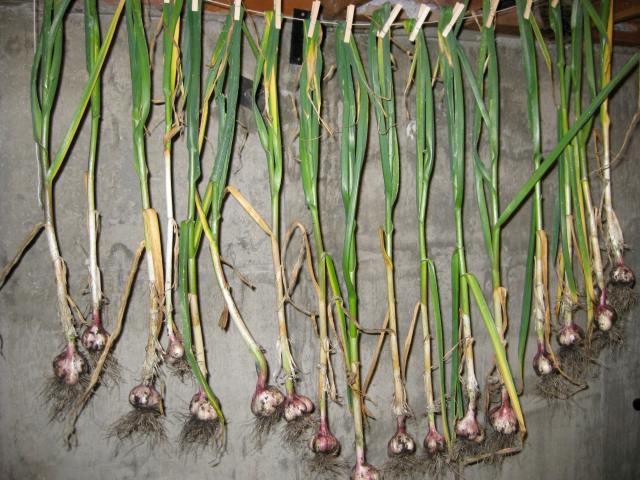
Next you’ll want to cure your garlic in a dark and dry location (if you want to eat a bulb right away, go ahead! Curing it just makes it keep longer). I use my basement and then keep them stored there until I am ready to use them. I have a very expensive and highly technical set up that consists of two screws in the ceiling with a piece of string tied between them and clothespins as the garlic attaching devices. Make sure to keep the drying garlic high in an area that is not accessible to pets because some pets (mainly a white cat called Bear) enjoy eating garlic leaves, breaking out in hives, and getting dragged to the vet. Your garlic will be completely dry in about 4-8 weeks and you can give them a brushing off to get rid of any remaining dirt and remove and discard the dried leaves.
IMG_3591

This year’s garlic was Red Russian, which is a hardneck variety, ordered from West Coast Seeds. I’ve grown a few different types before but Red Russian seems to give me the biggest and healthiest bulbs, so it is my go-to variety. This reminds me, I need to go order my bulbs for planting this fall!

Chinese Five Color Hot Pepper

I have never successfully grown a pepper from seed until very recently. A few years ago, I bought a jalapeno plant from the local nursery and was able to harvest one pepper from it. Somehow that tiny little bit of pathetic success went to my head. The next year I started a few pepper plants in the house from seed in the late winter and planted them in my raised bed in the spring. And I got nothing. You would think that would deter me from trying again. Last year – same story except I moved them out into my newly built greenhouse, planting them in the greenhouse’s raised bed. And NOTHING HAPPENED. Even the plants themselves didn’t get much taller than 5 inches and I had no flowers at all. I decided to try digging a few plants out in the fall, plopping them in some plastic pots and bringing them in the house to overwinter. Then some time in February, I decided to start a bunch more little peppers under lights. For some strange reason, those little plants lived for months in the house and even survived a renovation – by the time they went outside, they were covered in a layer of who-knows-what renovation dust. I transplanted them all into their own individual 8″ terra cotta pots and stuck them in the greenhouse. And I guess the pepper gods were shining down on me because I have a million peppers, including a ton of Chinese Five Color hot peppers.

IMG_3521

I purchased these seeds from Urban Harvest a few years ago. They are a rare hot pepper variety, although I have seen them popping up a bit more online in the last two years. Although they look very similar to the ornamental pepper plants that you see occasionally in the houseplant section at the grocery store and Home Depot, these are actually very different taste-wise. It is a very beautiful plant – medium sized, green foliage with purple veins and loaded with stunning rainbow colored peppers. The name is a bit obvious but in various stages of development, this pepper will be purple, yellow, pink, orange and red. The purple stage is the longest – it starts out as purple and matures to bright red. The peppers themselves are fairly small, about an inch long and 1/2 inch diameter but make up for their size in taste.

IMG_3541

I always make a point to read the reviews of hot peppers before I try growing them and I’d read mixed reviews of this one. Some people described it as weak and bland, while others said it is flavorful and very hot. I guess, like anything, it depends on your climate and growing conditions – and I’m sure it might even vary in taste from season to season. Like I mentioned, mine were grown in terra cotta pots in a hot greenhouse. My experience was good – I should mention that I am somewhat of a wimp when it comes to spicy food. I’m not a total baby and it is mostly due to a weak stomach, but I am nothing like my husband who loves burning his face off with spicy food. But yeah, these little guys pack a bit of punch. On the scoville scale that I viewed, this one is 30,000-50,000 which I interpreted as “sort of hot”, but I was a bit wrong after tasting it and have changed my interpretation to “hot but I’m not dying”. I also popped the whole thing in my mouth, seeds and all, in order to get the whole affect and flavor. It was good though and I would actually recommend pepper lovers to try this one out – it was easy to grow, the first hot pepper to ripen out of all of my peppers, and has a good amount of hot flavor.

I’m really glad that I stuck it out and kept trying to grow hot peppers. I know it’s different for everyone but what worked for me was the terra cotta pots – it allowed the soil in the pots to warm up really quickly and they seem to respond really well to that. Success! Oh and I mentioned above that I had overwintered a few of last year’s pepper plants in the house. And I will report that this made no difference whatsoever to crop timing. I was able to keep these alive throughout the winter and they even survived the move out to the greenhouse, but they ended up flowering and fruiting the same time as the peppers that I’d started indoors in February. And the yields were about the same. The only real difference is that last year’s plants are a little taller than this years. So I probably won’t bother with overwintering again.

I have a handful of other hot pepper varieties that I will feature in the next few weeks – including the Filius Blue hot pepper next week. And I’ve got a really exciting project in the upcoming year that involves a video camera, my partner in crime, and some scotch bonnet and ghost peppers.


Covet – My Imaginary Urban Farm

I’ve got chickens on the brain. Our neighbors, the city of Edmonton, just this week approved a backyard chicken pilot project. If you know me at all, you know that I am a huge supporter of urban farming, including backyard chickens. So this morning when I read that two city councilors from Calgary were hoping to bring a pilot project back to the table in the near future, I squealed in excitement. I may already have Chicken Land plans and a list of hen names stored in my brain – but maybe not because that would be something a crazy person does, right? Anyway, it got me thinking about urban farming, so I put together a little covet (wish-list) of things I would love to have if I had some extra money to blow and I didn’t have to worry about adult things like paying bills.

Copy of 1(2)

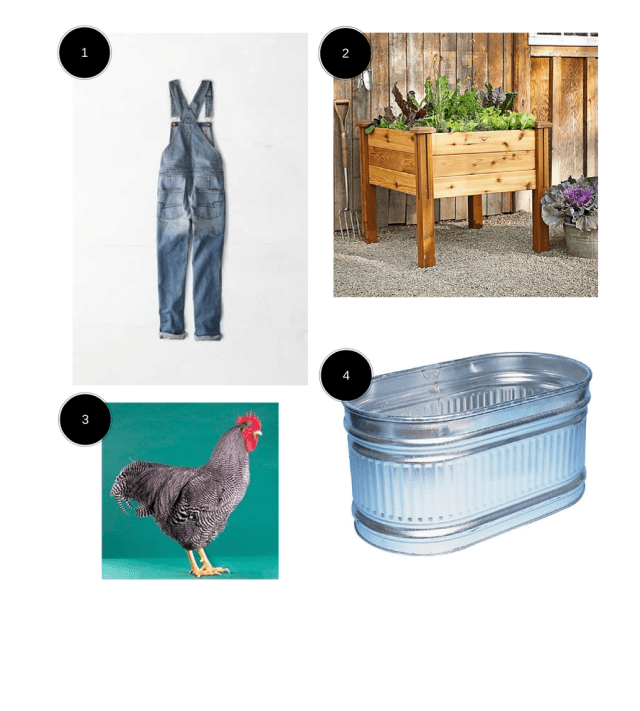
1. Overalls – American Eagle Outfitters $76.24CND but on sale right now for 50% off.

2. Raised Bed – Williams Sonoma $475CND

3. Barred Plymouth Rock Chicken – My Pet Chicken $2.45USD

4. Galvanized Steel Trough/Raised Bed – UFA $129.99-179.99CND

Looking back, nothing on this list is outrageously priced except maybe the Williams Sonoma planter (I actually have plans to build something similar with a cold frame attachment for my deck). I already own a galvanized steel livestock tank that I use as a raised bed and I love it, so I highly recommend it to anyone. And I seriously just ordered those overalls because every urban farming girl needs a pair of hip overalls but I’d held off on buying them because I thought they were too expensive (apparently I’m really cheap). Anyway, happy dreaming! Next time we’ll get back to reality with a post about my first ripe hot peppers!

Little Green Caterpillars from Outer Space

It might be more appropriate to call them Little Green Assholes. Little green caterpillar assholes that have ravaged my brassica crop, leaving it looking like the ends were sucked into a garburator and pulled out halfway through and then little drops of acid burned holes through the remaining leaves. In other words, they look terrible and I want to kill all the Little Green Assholes.

IMG_2472

Two of the caterpillars feasting on a broccoli leaf. And they blend in quite well!

I did a bit of quick internet research and came to the conclusion that these are cabbage loopers. Little green caterpillars that live on the leaves and munch their way through. At first, I thought the holes were from hail damage – we’d had two minor hail storms that didn’t do much damage to the garden, but did tear holes through some other plants. Then last week I noticed that the brassicas really had a lot of holes and it wasn’t from hail damage. That was when I looked a bit closer and noticed these little green caterpillars all over the leaves. I went through a flood of emotions, first shrieking “ew ew ew!”, then anger, then rationality. I found out what they were and why they were eating my broccoli and cauliflower. And then I read about how I can murder them and their entire family and prevent them from ever stepping foot on my property again. Basically, they love brassicas – so broccoli, cauliflower, collards, kale, kohlrabi, etc. But when they are finished with those, they may go ahead and start feasting on your tomatoes. No god damn way. Yeah sure, take my broccoli, whatever. Think about touching my tomatoes and I’m going postal on you.

IMG_3502

So what did I do? Well, I don’t like using insecticides, but I felt like it was a bit too late to deal with them by planting other things that would attract beneficial insects that may or may not eat the caterpillars. So I filled a bucket full of hot soapy water, threw on a pair of gloves and picked them all off the plants one by one until I’d destroyed the entire population (or at least the population in my yard). When I was sure that they were drown, I drained out the water and squished the little bastards, leaving the mashed pile on the ground as a warning to their friends (not really). Then I burned my gloves and stuck my hands in a bucket of sanitizer (also, not really). I’m pretty sure that my broccoli and cauliflower is done with and I’m probably best off pulling it out and throwing it right into the garbage bin, destroying any eggs that the caterpillars may have left behind.

IMG_3510

At a glance it really does look like it could be hail damage but even the young leaves are ripped to stripped almost clean to the veins.

I read that the best way to prevent cabbage loopers and other brassica loving insects from attacking your crops is to throw cloth row covers on as soon as you plant them (ugly but apparently effective). I’m not convinced that I will invest in row covers as I’ve never actually had any luck with brassicas, besides kale. This year was an experiment, so it’s not like I was looking forward to an amazing crop. But at the same time, it is very disappointing when anything doesn’t work out in the garden. I also mentioned that you can deter these insects and attract other beneficial insects by planting specific things, such as marigolds. The funny thing is that I did have marigolds planted in the same bed, but at the end near the tomatoes to deter aphids, so perhaps more strategic inter-planting would have helped a bit. The good news is that the tomatoes seem to be unharmed. If you’ve had any experience with cabbage loopers please leave your feedback in the comments section – I’d love to hear how you dealt with the little savages!

The Garden August 2014

I can’t believe that August is half over and it will soon be autumn. This season has whizzed by and I feel like I planted the garden just yesterday. It definitely doesn’t look like that though. Everything is full and lush and in an overall insane state (but good insane). We’re working hard on keeping up with the garden bounty, which is definitely not something I will complain about. I’ve also started jotting down some notes for next year of areas I would like to work on or things I would like to try planting (my seed list is up to like 30 things, somebody stop me now).

IMG_3377

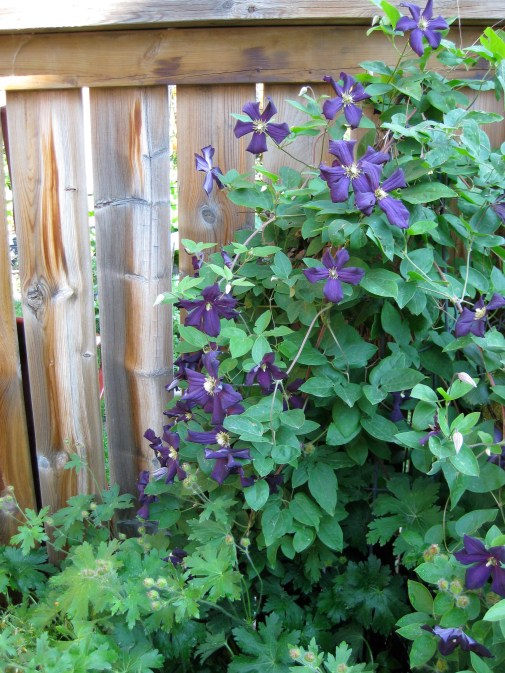
My only non-alpine clematis (variety unknown) that I have managed to keep alive in my garden. I’m so glad I decided to keep a few non-edible perennials in my vegetable growing spaces, especially vertical plants. 

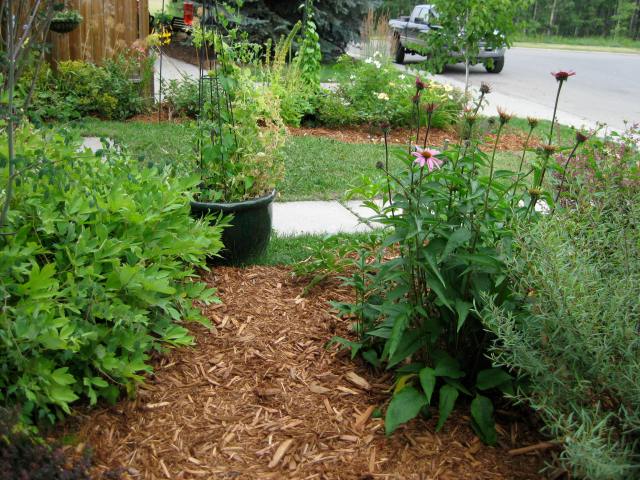
My staycation has ended so work in the garden has slowed down quite a bit, although I am basically going directly from my car in to the garden when I get home every afternoon, desperate to get my gloved hands dirty. This week I was able to prune and tie back my tomato plants, pull the spent delphiniums, as well as finally finish mulching the front yard with cardboard underneath fresh shredded cedar (that is of course until I rip out more lawn – NO LAWN IS SAFE, YOUR DAYS ARE NUMBERED!). I still have about a cubic yard of mulch left in the alley, so I’ll spread a fresh layer in the back yard and throw some around Compost Land in the back alley to keep things looking a bit neater. What a difference the mulch makes – I love the way it looks and smells, not to mention that it keeps many of the weeds down, making maintaining the garden just a little bit easier.

IMG_3471

One of the raised beds overflowing with corn, runner beans, squash, tomatoes, zinnia and marigolds. Lettuces planted in the ground in front. A few holes in things from either hail or insects, but most everything still looks great. 

And no doubt you’re sitting on the edge of your seat waiting for me to tell you what else I actually accomplished on my staycation. So here is the final update on that:
– Processed 12L of sour cherries. I am saying right now that I will never bring home 12L of sour cherries again. But I only half believe that statement. The most painful part was pitting them one by one “click…click…click”. And it looked like a murder scene outside where I’d sat and pitted them all. Pitting cherries is a long and dirty job. I ended up freezing about 4L, baked an amazing clafoutis, made homemade maraschino cherries using liqueur (delicious little alcohol soaked gems), infused sour cherry bourbon, and then spent a few hours over a boiling water bath making jam and preserves. It was a lot of work, but well worth it. I can say that now that its been a week and my resentment towards the cherries has dwindled.
– Planted a new sour cherry tree. Or rather, bush. Yeah because apparently I want more sour cherries. The variety I planted was a Romeo and I already have a Juliet, so it seemed fitting to get the other star-crossed lover.
– Stained and installed the new privacy lattice. Staining lattice is the worst, it needs to be said. In retrospect, getting a can of spray stain would have been a really good idea. Regardless, the lattice is up and it looks pretty good – it has given me an extra foot and a half of height on my fence for about 12 feet of width starting where the fence meets the house. I planted 3 alpine clematis along the fence as well – I’d originally wanted to plant 6 but my wallet just didn’t allow it at the time. I’ve kept space open for 3 more plants and I’ll try to buy them at end of season sales. It might not be totally necessary because alpine clematis fill in pretty well over time, but I’m feeling a bit impatient about this project and I’d like to see results next year. It won’t give us a whole lot more privacy, but it will give us a little bit and that is pretty important to me in that particular space. It was also important for me to get the privacy lattice up this month – our current duplex neighbors are a short term rental and I didn’t want to feel like I was snubbing the next occupants by putting up privacy panels first thing when they moved in. Maybe I’m over-thinking it.
– Cleaned up the front yard – edged the lawn along the public sidewalk, weed whacked along our side walk and chopped off the dandelion heads before they go to seed. I don’t tend the lawn in my front yard except for the occasional mow – it is horribly neglected and I could really care less. As I mentioned above and in earlier posts (and if you know me IRL, you’ve most likely heard me moan about my hatred for sod in casual conversation), the plan is for all of the front lawn to go and be replaced with perennial and food growing space. So caring for the lawn in the meantime is pretty low on my priority list. Regardless, I spent a couple of hours cleaning it up a bit and it does look much better.

IMG_3491

Coming from the front yard into the back – everything is so lush!

IMG_3487

Rare shot of the front yard with all of its fresh mulch. The perennial gardens in the front yard are relatively new, about 3-4 years old, so this is the first year that a lot of perennials are really becoming established and full-looking. I’m sure as time goes on and more of the lawn goes, I will be more inclined to post wide shots of the front gardens.

That’s it. So between all of those things and the mulch, I’ve gotten quite a bit done. I still have a few little projects like painting the wheel barrow and the front door, but there really isn’t much. I won’t be planting any flowering bulbs this fall because until I pull out more of the front lawn, there really isn’t much space available. Plus I always forget where my bulbs actually are, so the chances of digging up some bulbs in the process of planting new ones is highly likely. I am planning to plant some garlic in October (that reminds me that I need to order garlic bulbs), but otherwise my planting is done for the year. I’ll just continue to weed the garden, keep up with the harvests and then get ready for the autumn clean up.