The Garden Mid-July

I love this time of year because it seems like from the end of May up until now it has just been a waiting game. May is the busy month, especially this year as we were doing some renovations inside of the house and I decided I would go away for a week during the long weekend (great idea, Megan). June is usually rainy and miserable and nothing really seems to happen in the garden. Then a week of really hot weather and BOOM, it actually looks like a real garden.

IMG_3290I’m not hiding anything here – weeds & hoses everywhere are kind of my style. 

All of this is really exciting, but I am ultimately a pessimist, so every time I see the garden all I can think about is all the shit that I need to get done. I had a lovely list for the July long weekend. How much of that actually got done? Well, just one thing. It was a big thing though, so I can’t be too hard on myself. Sod Mountain! That ugly, weedy pile of sod has been cleaned up (see previous post here). And I have actual raspberry plants! The raspberries were there before, you just couldn’t tell because they were surrounded by a 4 foot high pile of dirt and weeds.

I actually haven’t been spending a ton of time out in the garden the last couple of weeks aside from watering every day and it does show. Everything needs to be weeded, I have a mess of hoses lying around the yard, and my shed is a dumping ground for everything we don’t feel like dealing with. But the good news is that I have a stay-cation starting this week and I’ll have a ton of time to deal with all things unruly.

Neglect aside, the garden is actually looking quite lovely and I’ve already been taking notes for things I want to do next year – like make little chicken wire domes for my young squash plants, plant some privacy clematis along the fence we share with our neighbors, and build a privacy pergola on the raised part of our deck. I’ve also already picked out some new tomato varieties I want to grow and I haven’t even had a ripe tomato off of this year’s plants. Get ahead of myself much? I also have an ultimate plan for the front garden, which includes raised beds for growing more vegetables. But I think the front yard is going to take a few years to come into fruition – we’re very stubborn people and we don’t like to hire people to do things we could do ourselves, which unfortunately means we have to show some patience.

IMG_3297The first tomatoes on the tumbler tomatoes I started from seed. Things are a couple of weeks late this year – come on tomatoes!

The greenhouse has been a huge success this year and this is very exciting for me. It is the first full year with the greenhouse so everything has been an experiment. I’ve got some pickling cucumbers that are about a day away from being ready to eat, tons of hot peppers (looking forward to burning my face off with these), some eggplants which haven’t done too much yet and a watermelon that has just started making teeny tiny watermelons (SO CUTE).

IMG_3321Cucumber trying to escape out the vent.

On the ornamental side of things, lots of flowers have been showing their faces around these parts and there are a ton of bees as a result. My favorite has been the cat mint (I also love bringing it in the house and watching my cats go berserk) and the blue himalayan poppy (although mine was only blue in the first year it bloomed, now it’s pink/purple – very strange).
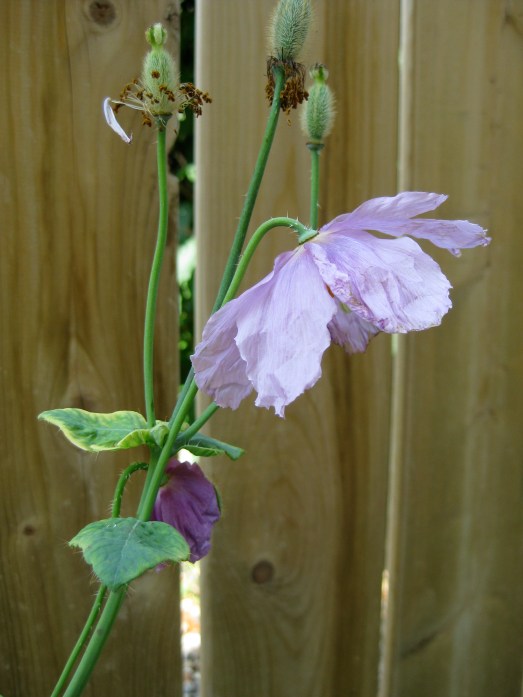
IMG_3337Blue himalayan poppy – not blue anymore. 

I have a couple of plans for this week – weed the whole garden, wrangle up some of those hoses and finish putting together my bird feeder pole (see that random 4×4 post in the first picture – yeah, I have some plans for that). I don’t think I’m being too ambitious here, so hopefully a few of these chores can get done and some of my garden guilt can subside.

 

Ladybugs

IMG_3205

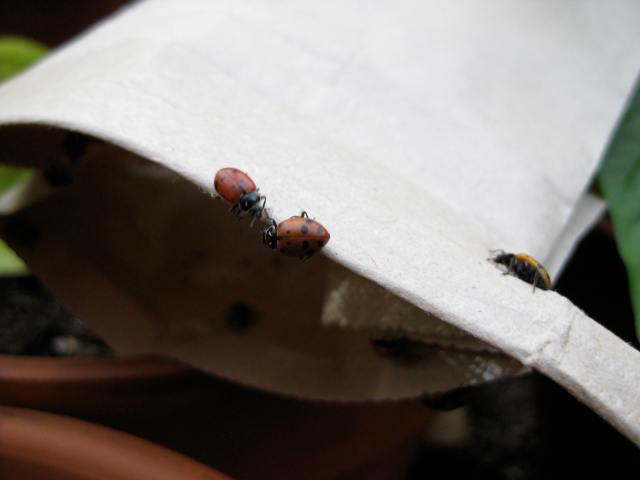
A couple of weeks ago I noticed quite a few little aphids in my greenhouse. I don’t like to spray my garden with any pesticides, so I decided to go the natural route and purchase some ladybugs from the nursery.

IMG_3208

Luckily my younger brother happens to be good friends with the owner of the nursery and had mentioned I would be coming by to pick up some ladybugs. The owner told my brother that the best thing you can do before releasing your ladybugs is to give all of your plants a good watering, leaves and all – the ladybugs are very thirsty coming out of the bag and the water will encourage them to stick around instead of just flying away. The instructions on the bag also said to release the ladybugs in the evening – it is more likely that they will settle in and find a place to snooze and then start eating in the early morning when the sun rises. I’ve also heard that you can spray them with a little sugar water or soda solution to make their wings sticky and prevent them from flying away, although it sounds a little cruel to me.

IMG_3194

My ladybugs seemed to be very grateful for the water and immediately stopped for a drink as they came out of the bag – then started crawling around the plants and doing their thing. I watched them for quite awhile just because they were so neat but also to get some photos. I closed the greenhouse door for the night and in the morning there were a ton of ladybugs hanging out on plants and in the soil. They definitely did their duty as all of the aphids disappeared. 

IMG_3203

Unfortunately the ladybugs flew off after their work had been completed but I like to think that they are living elsewhere in the garden, feasting on delicious little aphids.


Strawberries

Yesterday was the first strawberry harvest. I wasn’t planning on harvesting the strawberries yesterday morning until I saw a squirrel reach through the chicken wire fence I put up earlier in the season and help itself to a nice bright red berry. After witnessing that, I went outside with my bowl and picked all of the ripe strawberries (throwing away some half-eaten ones the squirrel had already half-dined on). The good news is that the squirrel hasn’t figured out how to get into the raised bed surrounded by the chicken wire fence, but he has figured out how to reach through and pull off ripe strawberries. I suspect I will have a few more harvests as there was tons of unripe berries.

IMG_3267

I’ve long since lost all of the tags that went along with my strawberry plants, but there is a mixture of everbearing plants that I bought at the greenhouse and alpine varieties that I started from seed – including mignonette and a white alpine variety. My favorite are the alpine varieties because they remind me of the wild strawberries that I used to pick when I was a youngster.

This year is the best strawberry harvest so far as I moved some of the plants around this past spring to give them all more room to grow. I would recommend giving new plants about a foot of space around one another – planting them too closely prevents airflow and creates shade under the berries, so sometimes they can go moldy in those conditions. In past years, I’ve just had enough strawberries to snack on as I putter about in the garden but I filled a small bowl yesterday, which was enough to put on top of gelato for three people. I bought a container of the bourbon vanilla bean gelato from Fiasco Gelato here in Calgary and it was perfect with the fresh strawberries.

I also decided early on in the season, after being frustrated by the price of annual hanging baskets, that I would fill all of my hanging baskets with strawberry plants this year. I am really happy with this spur of the moment decision because I’m going to get a ton of berries from these plants, not to mention that the hanging baskets cost me about $8 each in plants and soil to put together – yay frugality!

Covet

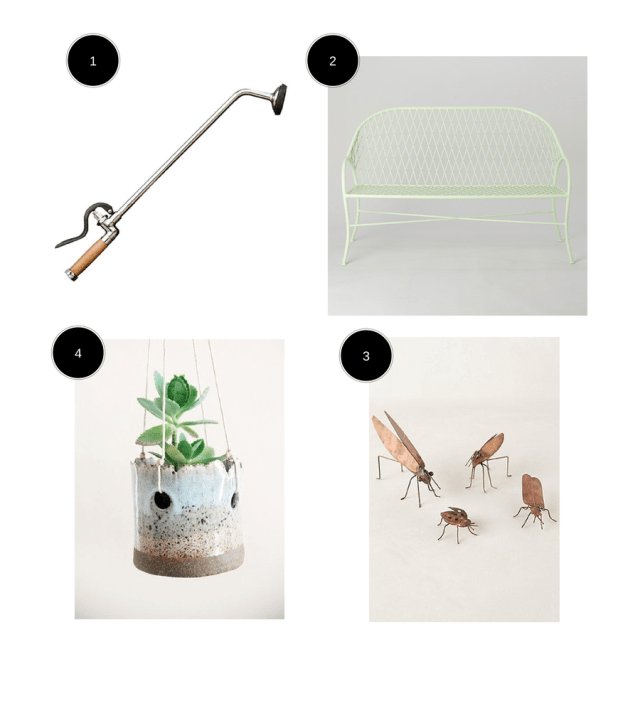
I`m a window shopper, especially on the internet. I will scour my favorite shopping sites and put items in my basket and then not buy any of them. So I thought it might be fun to put together some covet posts where we can all pretend we live in an imaginary world where we have an unlimited disposable income. Most of the items are way too expensive for me to even dream about, but sometimes I get ideas from these expensive items and try to come up with creative ways to affordably reproduce them. Don`t worry, I will be featuring some of my favorite affordable gardening items later – this is just fantasy gardening (that sounds like it should be dirty, but I didn`t mean it that way).

11. Watering Wand – Rejuvenation $170 USD

2. Jardiniere Bench – Terrain $228.50 USD (on sale!)

3. Copper Insects – Anthropologie $40 each USD

4. Small Hanging Pot – tw workshop $60 USD


Sod Mountain

The time finally came to deal with Sod Mountain. This was the dumping ground for the grass we removed from the back yard last year. A few years ago, right before we built our shed, we decided that we were going to clean up our alley in order to move our fence back about 6 feet and extend our yard a bit. Maybe a previous owner parked an RV in the back alley – that is really the only explanation I can find for why they required such a long parking spot back there. So why not move the fence back an extra few feet and extend the yard space. We had an old decrepit fence and a flimsy Rubbermaid shed that came with the house – the fence was removed and hauled to the city landfill and the shed was sold on Kijiji. We leveled out the back alley, moved the two compost bins, built a shed and then build a new fence. Amazing how adding an extra 6 feet of length to the yard can make it seem so much bigger! We still park our car in the alley and there is tons of room, so even when we decide to leave our home, someone with a longer truck or SUV can comfortably park in the spot without having to bulldoze the fence and shed.

IMG_3215Sod Mountain on July 1, 2014 – looking pretty terrible. There is a third composter and a raised raspberry bed back there!
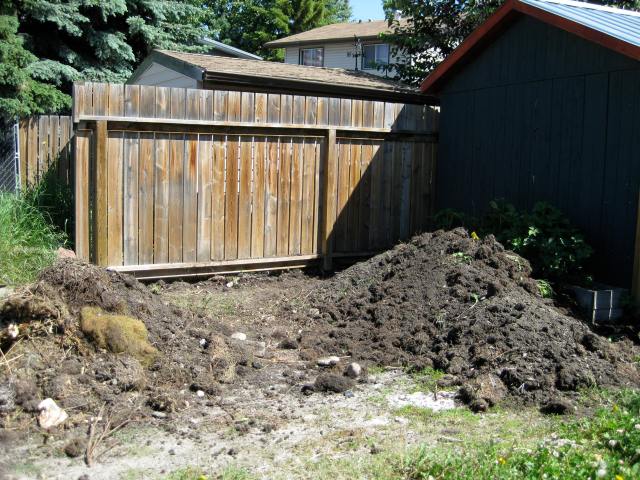
Since the initial cleanup a few years ago, we have added a narrow raised bed and another compost bin (the bin was free from the city!), bringing the composter total to 3. I had planted raspberry bushes in the raised bed, but you know the saying out of sight, out of mind? Yeah. Good intentions. I’d also filled the bed with well-rotted manure from my parent’s farm which is black gold, but the downside is that it is full of weed seeds. So it is mainly just a weed garden. I cleaned this up a bit now and have intentions of throwing down some mulch to keep the weeds in check. Maybe I’ll remember to water it – although the raspberries seem to be doing really well on absolutely nothing but neglect.

 So what does one do with a surplus of removed sod? It seemed way too good to just take it to the landfill – plus it would have taken us an entire weekend to haul it away in a hatchback and we’re too cheap to rent a truck. I’m sure someone with a truck on Kijiji would have taken it away for a fee but I tried to approach the old sod as something I could use instead of something I had to get rid of. I decided that a good idea would be to build a giant raised bed, where we could throw the sod in and allow it to slowly decompose and eventually be used as garden soil when needed. Because we do still park back in the alley, we decided to put the three compost bins on top of the raised bed. I also wanted an area that I could throw more sod onto as we continue to slowly remove the grass in the front yard.

So began the task of making room for the giant raised bed. We measured things out to see what the maximum size the raised bed could be. We decided on 4’x10’. Initially, we were just going to build it about a foot high, but decided to add an extra level of 2”x6”s to give it some more height. This turned out to be a good idea because we ended up needing that extra space right away. Plus, we made sure to build the corner braces in about 4 inches from the top of the bed so that in the event that we do want to add another level and build it higher, it would be really easy to attach everything together. That was my husband’s brilliant idea.

IMG_3218After moving the composters and making room for the new raised bed

The second step was making the space to lay down the raised bed – so we temporarily moved the compost bins out of the way, including their contents (all 3 were completely full and with a lot of materials that hadn’t yet decomposed because we’ve been awful about maintaining our bins) and started shoveling some of the sod out of the way. It sounds really easy, but actually it was kind of back breaking. I really wish that I had thought of this idea like a year or so ago when we first began sod mountain because then we could have just built the bed and thrown the waste right in. Oh well. That’s why I am telling you about this so maybe you’ll learn from my mistakes – I guess not necessarily a mistake, but just not thinking ahead.

Next we constructed the raised bed and built it into place ensuring that it was leveled on the ground. There are a lot of tutorials online for building your own raised bed – we had built our first raised bed using a set of instructions I’d found online but as we built more beds, we found out what worked well for us and went along with that. We used cedar 2”x6” boards, cedar 4”x4” posts as braces and 3” cedar decking screws. I’ve read online that new cedar can actually affect your vegetable growing abilities in the first couple of years due to something that exists in cedar naturally, but I’ve actually never had a problem with this. Or at least, I haven’t noticed anything. Maybe if I had more space I could experiment with different materials and see if there is any difference. But really, in my location, the only lumber options I have are pressure treated, cedar and spruce, so I have gone with the natural rot resistant option that has served me well for the last 5 years since we started building raised beds.

Before we began filling the raised bed, I stapled some landscaping fabric into place just above the top level gap inside the raised bed (this is so that dirt will not escape the gaps) – I didn’t want to put fabric on the ground as I want worms to come up into the bed and work their little wormy magic. When the bed was in place, we started shoveling the contents of Sod Mountain inside. By this time, it had started to get really hot outside and we were pretty tired. But determined. So we finished and somewhat leveled the composters on top. I was actually impressed with how much sod we actually had – and of course it will settle a bit and I’ll have some more room to throw more sod into. After the composters were in place we threw the original contents back into the bins, watered them, and secured the lids. Now hopefully we will remember to maintain these.

IMG_3250All done! I also stained that one back section of our fence (finally).

It really doesn’t look like much, but it was a huge amount of hard labour and we’re both really pleased with the results. I will be topping the exposed bits with some cardboard and cedar mulch to try and keep weeds and grass from taking over. When I need to add more sod to the pile, I’ll just lift this up and throw in the waste. I will probably eventually start planting things in this bed as well – can you imagine a pumpkin growing in this pile? Finally, we’ll finish up the area with a fresh load of gravel for the parking spot.

IMG_3251We can finally get to the raspberry bushes!

I’m probably going way over board in my effort to beautify my alley – frankly, the alley is mainly used as a dumping ground for broken crap & dirty old mattresses, but I just think it is such a waste of space if I do nothing with it. Or maybe I’m a pioneer and others in my neighborhood will follow. The point is, if you plan on removing your lawn it is a good idea to plan ahead and decide what you should do with the removed sod. We didn’t really have a plan and we were just going to dispose of it, but I’m happy we didn’t and ended up turning it into something useful.