The Garden October 2014

I keep hearing myself and others say that they can’t believe it’s October already. September was a really long month, but it flew by in a flash. Work was extremely busy so I was putting in long days and I’ve been trying to keep up with the garden, writing blog posts, ensuring the house is in a livable condition and all of the other life things. I love to cook but I found myself just throwing together easy and quick stand-bys all month. Oh and I also decided somewhere along the line that I could knit a sweater as well as a few holiday gifts. Idiot.

I don’t want the season to end, but I will say that sometimes caring for the garden when the season is coming to a close after a long and stressful day at work can be a bit of a burden. Do I really want to water my garden after working an 11 hour day? Not really. But on the other hand, after I’m outside for even a minute, I can see myself becoming calm and relaxed. I once read an interview with Scott Weiland (former Stone Temple Pilots singer – I just totally dated myself) who talked about how gardening and knitting helped him overcome drug addiction. So needless to say, gardening and knitting are unbelievably therapeutic and both myself and Scott Weiland are living proof.

October is a weird month for me – most of the vegetables have been harvested and preserved and many of the perennials are expiring. This time of year always puts me into a state of mourning – mourning the loss of this year’s garden that I worked so hard on and preparing for the dark and cold season ahead. It sounds so depressing – and it is, to an extent. But I also feel relief because I can just let go, but also feel excitement towards planning for the next season – I believe this is what keeps us gardeners going during those dreadful months.

So how about enough of the depressing talk and instead you look at some photos of the garden right now.

IMG_3749

Most of the raised beds and pots are cleared but a few things remain – I’ve left the carrots in for now because they don’t mind frost, same with the kale and other brassicas (better picture of those below). You may or may not notice that my neighbor’s tree has bent over into my yard quite a bit – this is a result of the heavy snowfall we had a few weeks ago (heavy snow + full leaves + my hops using the tree as a trellis = very heavy branches). It may or may not straighten itself out over time but I don’t mind too much because it isn’t a safety hazard and I tend to refrain from complaining about my neighbors when it comes to property lines because I know that a few of my plants cross the lines quite frequently (I’m looking at you hops!). I try my best to prevent this and not be a terrible neighbor – I would never intentionally plant something that I knew would spread to my neighbor’s yard and I always make a point to talk to my neighbors about my trespassing plants. Luckily my gardening neighbor always has the same response “Oh, I don’t care!”, but I guess I have a fear of angering people.

IMG_3722

The garlic was planted last weekend! I went with old faithful Russian Red again. I planted it in the ground between two raised beds where I planted lettuces this year. When I did some re-arranging of raised beds a couple of years ago, I intentionally left a wider walking path between the beds so that I could have some room to plant in ground – this has turned out to be the perfect solution for perennial herbs and garlic.

IMG_3757

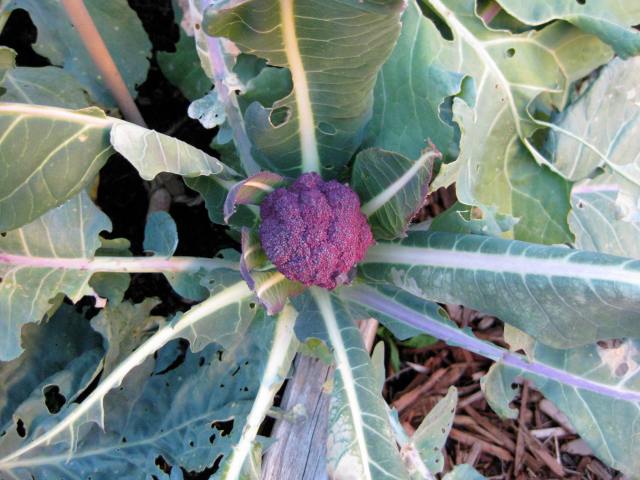
I’m so glad I got too lazy to rip out the brassica bed after the cabbage looper mass murder. I haven’t seen another caterpillar since and the plants have come back fairly strong, growing new healthy leaves with two of the plants producing heads. I know I said that I hadn’t had any success with broccoli and cauliflower in the past and that this was a failed experiment and I wouldn’t try again, but I’m happy to say that I was completely wrong. Sometimes there is light at the end of the tunnel full of caterpillar carcasses.

I have a feeling that the next time you see the full garden, it will be covered in a blanket of white. Sigh. What does your garden look like right now? Are you still harvesting?

One more thing: I know a lot of people follow blogs on Facebook, so I recently created a page for my blog where I will post status updates, links to new blog posts, as well as anything else I feel like subjecting my followers to, so please like Carrots & Raspberries on Facebook!
2014 Tomatoes Part Two

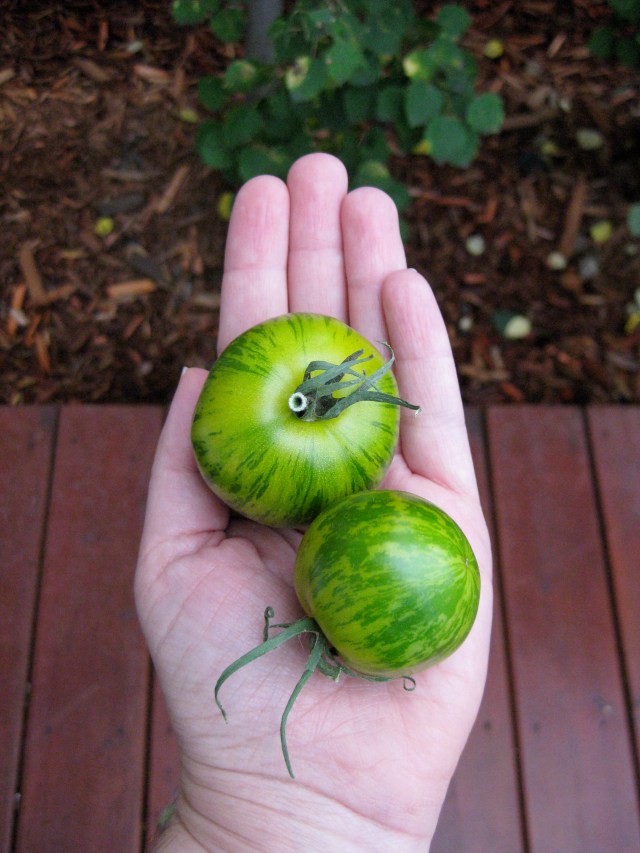
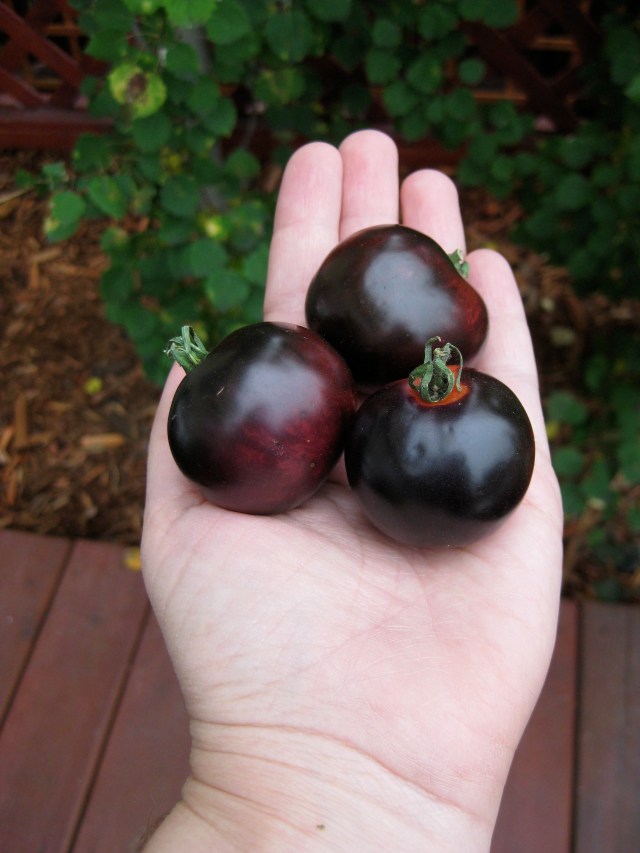
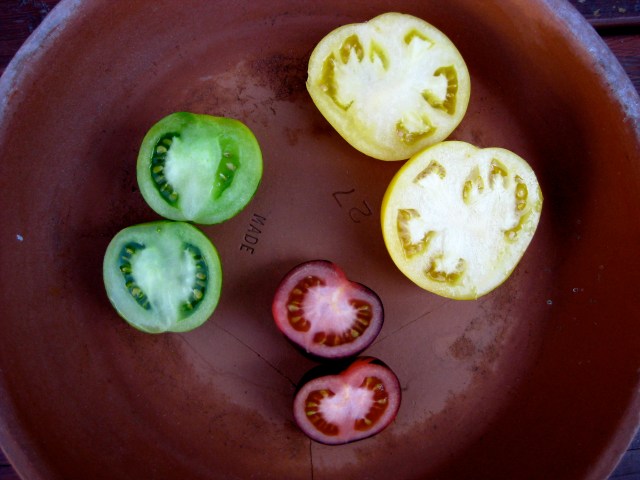
As you might remember, a few weeks ago I harvested almost all of my tomatoes and brought them inside due to a summer snow storm in the forecast – the tomatoes that remained outside were in pots that were moved to my unheated greenhouse, where they were just fine. And although the bulk of the tomatoes I brought indoors were green, they have been steadily ripening inside of cardboard boxes in my dining room. Today I wanted to share some of the medium sized tomatoes which are the most colorful of them all and let you know my thoughts on growing and eating them: Taxi, Green Zebra and Indigo Rose.

IMG_3740

Clockwise from top – Taxi, Indigo Rose, Green Zebra

IMG_3705

Taxi

This was my second time growing this determine variety. I originally purchased the seeds because I was looking for a non-cherry yellow determine tomato. I’m going to be honest and say that this tomato was a bit of a flop this year – it only produced one tomato. One. The plant itself also did not do very well – the foliage was unhealthy looking for most of the year. I have no real explanation for this except that perhaps I did not provide it with enough fertilizer throughout the growing season – or it just wasn’t impressed with the location I placed it (although this is not a strong argument as I had other tomatoes growing in the same location that did exceptionally well). As for the taste, that is definitely something worth mentioning: it isn’t anything very exciting. If you like a mild tomato with a very delicate flavor, little-to-no acidity, and a mushy texture, then this is the tomato for you (and maybe that is yellow tomatoes in general). I have to admit that I like a bit more punch with my homegrown tomatoes, although this one balances out strong flavors if I’m making fresh salsa with a few different varieties of tomatoes thrown in together. So would I grow it again? Probably not. Putting aside the fact that I only got one tomato from my plant, it just isn’t a very exciting tomato and I would rather use the space to grow a tomato that wasn’t this boring. Sorry Taxi.

IMG_3702

Green Zebra

Green Zebra is one of my favorite indeterminate varieties ever. I’ve grown it for about 4 years now and it has never failed me, always producing a ton of medium sized tomatoes on very healthy plants. The tomatoes ripen to a yellow/green color and you know they’re ready to eat when the skin has a little give when squeezed. My partner and I have differing opinions when it comes to the taste of this one – he found it too tart and acidity, but I thought it had just the right amount of tartness with a bit of sweetness. And I love the texture of this one. This tomato is going to remain on my “must grow” list.

IMG_3718

Indigo Rose

This was my first time successfully growing this indeterminate variety (I’d attempted last year, but squirrels). I purchased it because who wouldn’t want to try growing a blue tomato? I would describe the coloring as a dark purple (almost black in places) with dark red blushing – extremely beautiful. They were also very easy to grow, produced many tomatoes, and the plants remained very healthy all year – the ideal tomato plant in my opinion. The other thing to point out is that although they are an indeterminate variety, they are quite compact plants – not as compact as a determinate, but somewhere in between an indeterminate and determinate variety, which worked very well in my small space garden. I was skeptical that such a pretty tomato would have a forgettable taste but the taste is wonderful. They are very sweet with low acidity and have somewhat of a plum flavor and texture. Indigo Rose is absolutely in my top 3 tomatoes this year.

I’d love to hear about the tomatoes that you grew this year and I’d also love to hear any of your suggestions for a yellow variety.

Indigo Rose and Green Zebra seeds purchased from Urban Harvest, Taxi purchase from West Coast Seeds.

Sweet Cherry Red Pepper

I only grew one sweet pepper variety this year because I figured that sweet peppers are easy enough to buy at the store and/or farmer’s market and I assumed there wouldn’t be any real difference in taste. Wrong. As a gardener I should really know better.

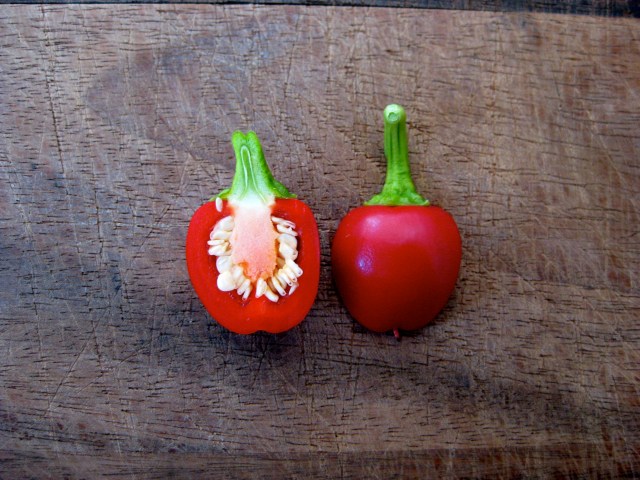
So the sweet peppers that I grew, Sweet Cherry Red, were delicious. I let them ripen as long as I could on the plants and picked them when they were a deep bright red. The taste is similar to a miniature sweet pepper that you would buy at the farmer’s market but a little sweeter and more intensely flavored.

IMG_3658

The plant itself was nothing too exciting. It is a somewhat compact plant, growing around a foot tall, with green foliage. The peppers themselves are bite sized, although I would caution against just popping in your mouth – they contain a lot of seeds.

IMG_3662

My only other complaint besides the seeds is that the plants only produce a small handful of peppers. I grew 3 of these plants and got about a dozen peppers altogether. So depending on how you look at it, it probably wasn’t really worth it to grow for only 4 miniature peppers per plant. But I would argue that the taste was worth it. If I were to grow this variety again, I would probably just opt for one plant and use the additional space for growing other varieties. I have my eye on a number of other sweet peppers to try next year, because obviously they do not taste the same as the ones you buy in the store. Sometimes when I sit back and think about my reasoning for things, I realize how much of a crazy person I actually sound like.

Next week I will discuss the NuMex Joe E. Parker hot pepper.

Sweet Cherry Red Peppers, Botanical Interests. No longer available on their own but the link is a mix that includes Sweet Cherry Red.

2014 Tomatoes Part One

If I were ever told that I had to choose only one plant to grow in my garden, I would choose tomatoes. And if there is any plant that I have a weakness for when it comes to new-to-me varieties, it is tomatoes (although peppers are now at a close second place). In the dead of winter when all I can do is sit wrapped in a wool blanket staring endlessly at my snow covered yard in a deep depression (I’m exaggerating a bit), I turn to the seed catalogs and websites and try to find ways of justifying tomato seed purchases. I know I don’t need any more seeds. I have more seeds than I could ever really grow in this space. But still, the excitement of trying a new variety outweighs rationality and I end up buying more seeds.

I remember sitting down at my kitchen table this last winter and laying out all the tomato seed packets. I currently have around 30 varieties, which by some hardcore tomato-loving gardeners is peanuts in comparison to their stashes. But for me, that’s overkill. Is it going to stop me from buying more seeds this next winter? Probably not. Regardless, I sat at my kitchen table in front of the seeds and realized I was going to need to make some hard decisions. Either, I cut back on the amount of non-tomato things that I grow in order to have more tomato growing space or I cut back on the tomatoes. I went with the latter. I decided to pull out all of the determinate varieties. In other words, varieties that are pretty compact, stop growing at a certain point, and that will ripen pretty much all of their fruit around the same time. Determinate tomatoes are excellent candidates for growing in pots because of their size restrictions and the fact that they rarely need staking. I have a lot of pots and they are easy to kind of stick wherever, so I started one plant of each of my determinate varieties. Easy. Same with the tumbling and dwarf varieties – they are even more compact and I’ve gotten away with planting multiples in the same pot or even sticking some tumbling into hanging baskets with other plants. Easy. Then came the indeterminate varieties – those which require staking and often grow very tall and unruly. They can even benefit from multiple prunings throughout the season. Indeterminate tomatoes can be planted in large pots, but in my experience it is easier to plant them in the ground or a raised bed because of how big they can (and will) grow. So when it came to my indeterminate hoard, I had to make some decisions. I based my choices on a few factors: I wanted to plant each of the brand new varieties I’d purchased and I wanted to plant varieties that I grown before and had good success with. If there was something that I’d successfully grown from seed in the past but it hadn’t produced well or that had something-to-be-desired taste results, it did not make the cut. I also wanted to ensure that I was planting one color of each tomato that I had (I am a sucker for colorful tomatoes!). I started 26 tomato plants indoors (some were multiples of the tumbling and dwarf varieties I mentioned above), but I did lose a few plants to squirrels in the early spring. So altogether I ended up with 16 plants (it was a really bad spring for squirrels).

So that brings me to Part I of my tomato posts. The first three tomatoes that I will be featuring are all indeterminate cherry varieties: Pink Bumble Bee, Green Grape and Black Cherry.

IMG_3689

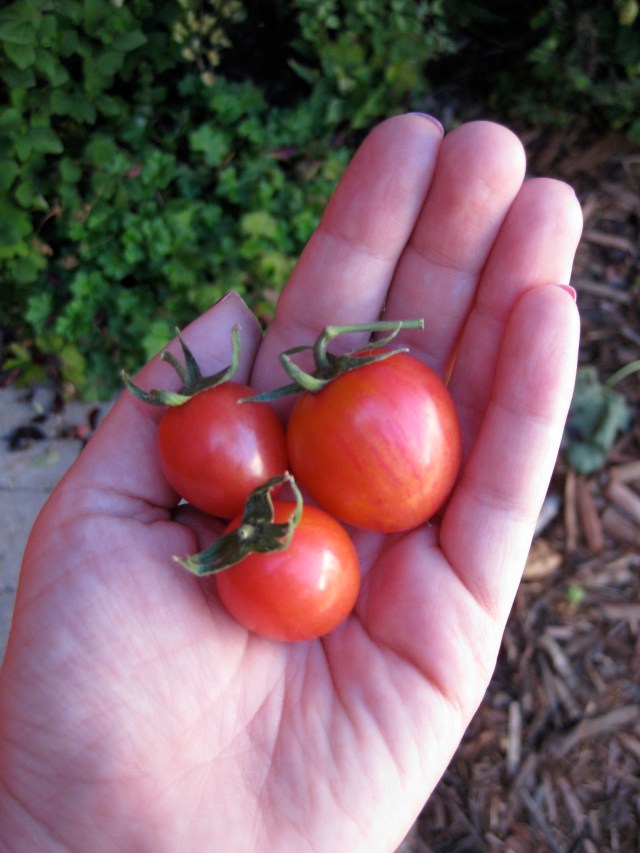
Left to right: Pink Bumble Bee, Black Cherry, Green Grape

IMG_3674

Black Cherry

This was my fourth year growing this variety. I would be surprised if there was a year I did not grow Black Cherry – I have always had good results with this variety and Black Cherry is always a vigorous producer and the first of my indeterminate varieties to ripen. The tomatoes themselves are a darkish red/purple, transforming into a darker shade around the stem. I would describe the taste and texture as almost the perfect cherry. The flavor is a mild sweetness with very little acidity. I don’t think I need to say it, but I will grow this again – still a winner.

IMG_3677

Pink Bumble Bee

This is a new-to-me variety this year. I chose this variety because I didn’t have a pink tomato and I also love striped varieties. The plant wasn’t a prolific producer (it wasn’t terrible, just not good), but the plant did remain healthy throughout the whole growing season. The striping is a bit hard to notice unless you really look at it and was most evident in the larger tomatoes – it is more of a reddish/pink with orange striping, although distinguishable from Tigerella, which is a different red/orange striped tomato that I have grown in the past. Although none of the tomatoes had an opportunity to ripen on the vines, they were one of the earlier tomatoes to ripen indoors. The taste was good – sweet but with a slight acidity. The texture was okay – not unpleasant but not nearly as nice as Black Cherry. As far as a pink tomato goes, it wasn’t really very pink so next year I might try another true pink variety. I’m a bit torn if I’ll grow this variety again – it wasn’t bad, but it wasn’t amazing.

IMG_3683

Green Grape

Another new-to-me variety this year. I have only grown one other green tomato variety and I really love it (Green Zebra – but I recently learned this variety was bred by the same fellow who bred the Green Zebra). The tomatoes ripen to a bright, almost neon yellow color with some bright green shading around the stem and you’ll know they are ready when the fruit has a little give when lightly squeezed. The first year I grew a green tomato variety I was very confused as to ripening time, but now I can usually tell just looking at it. This plant produced about as well as the Pink Bumble Bee but did stay healthy throughout the season. Similar to the Pink Bumble Bee, these did not have an opportunity to ripen on the vines but they did ripen inside quickly. I would describe the taste as mild, not very acidic, and with a simple sweetness. The texture was similar to the pleasant texture of Black Cherry. I really liked this tomato and I will definitely grow it again.

That brings my first tomato post to a wrap. I would love to hear about some of the tomatoes that you grow – whether it was a new variety or one that you’ve grown year after year. Let’s talk tomatoes!

Green Grape and Pink Bumble Bee seeds from Baker Creek Heirloom Seeds, Black Cherry seeds from Urban Harvest (although unavailable at this time, but available from Baker Creek Heirloom Seeds here).

The Garden is Dying

After last week’s summer winter storm, the garden took a bit of a hit. The damage wasn’t totally apparent until this last weekend when the snow had melted away and the sun had come out. There was a leftover patch of snow in front of my greenhouse this morning, reminding me that it’ll be back soon “Don’t get too comfortable!”.

The nights are supposed to be warmer which means I brought the poor potted tomatoes out from the greenhouse again – they’d been shoved on the floor where they were getting no direct sunlight, but at least they weren’t frozen. Maybe they’ll have a chance of ripening outdoors unlike all the other tomatoes that were harvested green a little over a week ago (some are very slowly ripening in the house).

But as for the rest of the garden, it is a mixed bag. We cleaned out three beds completely on the weekend – the raised bed that had corn, squash, beans and a couple of tomato plants, the galvanized steel livestock tank that had the indeterminate tomatoes, and the little in-ground bed that I had planted lettuces and marigolds. A few pots were cleaned out that contained the dead corpses of squash and some annual flowers like dahlia, morning glory, coreopsis, and nasturtium. I could have just left the dead plants in place, but frankly it was depressing.

IMG_3639

The good news is that there were a lot of troopers that did survive and will continue on until real winter hits, such as kale, beets, carrots, some herbs and the broccoli and cauliflower I was supposed to pull out but got too lazy. That’s right – the caterpillar damaged crop is still in place and actually doing pretty well. I haven’t seen another caterpillar since I destroyed the population back in August. And wouldn’t you know it, there are actually heads growing! I guess laziness pays off sometimes.

IMG_3644

The rest of the damage was a result of the weight of the snow. Quite a few of my perennials are nearly flat on the ground and won’t bounce back this year. My columnar aspen trees were not looking so columnar, so we used Velcro ties to try to get the branches back in place.

IMG_3637

Sadly the season is coming to an end and much earlier than I would like. The rest of September will be spent slowly harvesting the remaining crops, tending the greenhouse, and cleaning up the yard as plants expire. Since we are living out of a mini-fridge for now, I will probably spend a day in the near future canning beets.

I’ve already noticed that I’m spending a lot more time indoors and my trips to the garden are a lot more brief – the weeds have slowed down and I haven’t had to do much watering besides a can here and there to the greenhouse. As for outdoor projects, those are pretty much done for the year – I do still have the bottom side of my wheelbarrow to paint, but that is pretty much it. And the indoor projects are beginning again – knitting (time to start holiday gifts), updating my Etsy shop, doing a few minor updates around the house, cleaning the basement (thank you community association for hosting the annual free garbage day!), and pumping myself up to finish the powder room we renovated back in May. Let’s hope I have a few more weeks to enjoy the garden before I really settle myself in for the winter.