Sewing A Blouse & My Mistakes

I know I mentioned at the beginning of the year that I had a bunch of new skills I wanted to learn this year, such as entomology pinning and wood carving, but I failed to mention that I want to take on more personal sewing projects. I’ve been spending quite a bit of my spare time making aprons for my Etsy shop and private orders, but besides that I haven’t done any sewing for myself. There are a number of sewing projects on my personal to-do list including a wrap dress (I’ve had the pattern for two or three years now?), a quilt (I have the fabric all ready for this one too!), and a raincoat (let’s not talk about this one – I’ve had the fabric AND pattern for like 5 years for this one). Doesn’t it always seem I have a million projects I want to do? Yes. But anyway, the first priority project for me was a blouse.

Let me back up. I have basically no experience when it comes to sewing clothing – it just seemed so daunting to me (quilts, aprons, bags – no problem! Clothing – eek!). What if it doesn’t fit? What if it looks like crap? What if I just spend $50 on materials, plus hours of my time, and I hate the end result? After all, it’s not like knitting – if you screw it up or hate it, you can just unravel it and make something else. Well, I decided to take the plunge. But not just a little plunge in the kiddy pool, it was a dive in to the deep end. Not only did I make a shirt, I made the pattern myself. Go big or go home, I guess.

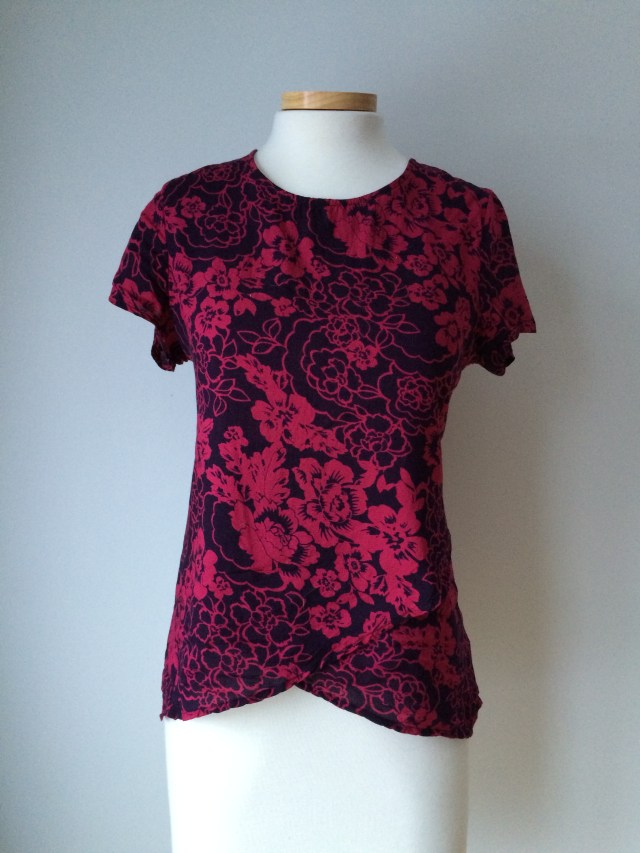
I actually started with a shirt that I bought from Gap Outlet that I love the look and fit of. I decided that I didn’t want it to be exactly the same so I would include some slight alterations. The major alteration being that I wanted my version to be sleeveless. I almost always wear cardigans or blazers over my blouses, so sleeveless is my preference. The thing I liked most about the original blouse was the front – it is actually two pieces of fabric layered to create a nice little tulip front.
IMG_3053

See? The Gap shirt is really pretty with a nice shape.

First I drew a rough outline of the original shirt using a few pieces of paper taped together from a roll of light kraft paper I already had on hand. I bought this roll awhile back at Benjamin Moore and it is for covering floors and such while painting, but this roll is so handy for basically everything, especially making patterns. The back piece of the shirt was the easiest to trace but doing the front was a bit more tricky and I actually ended up screwing it up a bit (no project is without its obstacles – we’ll get to this later). After I was finished tracing out the pieces, I held them together to make sure they would fit, did a bit of trimming to ensure the pieces were even, and then added about 1/4 around each piece for seam allowances. This is all so scientific and interesting – basically, I winged the entire thing.
IMG_3056

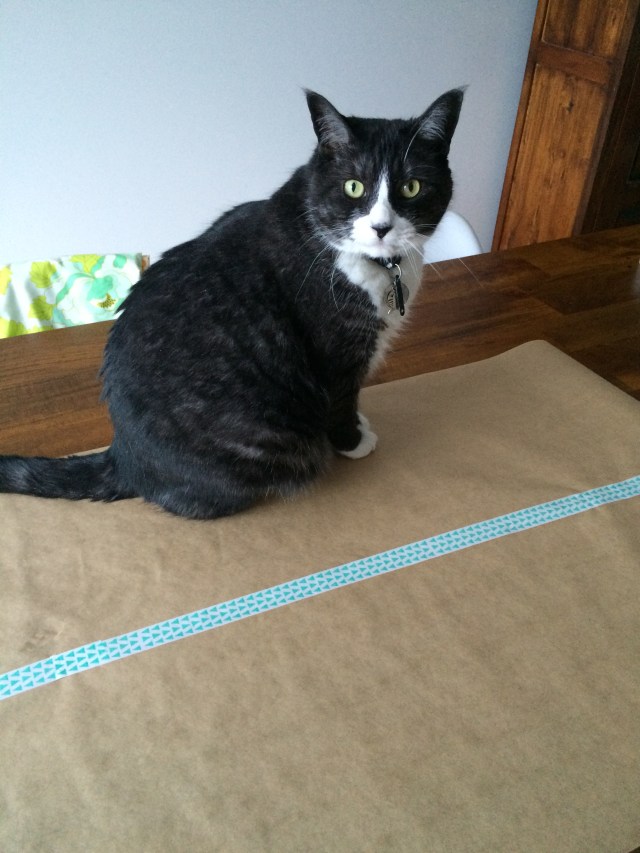
The cat helped me make my pattern.

One of the most difficult parts of the whole planning process, other than fixing my screw up (I will get to this) was actually choosing fabric. The original shirt was a nice flight flowing cotton but I didn’t have anything like that on hand. For about a year I’ve been holding on to a quilting weight fabric from my favorite artist, Leah Duncan. I had considered turning it in to a dress last summer (with that pattern I’ve been holding on to for three years) but chickened out at the last minute. I waffled for a bit on using a quilting weight fabric since it is heavier and may not translate too well on to apparel. But I guess I was feeling brave because I went ahead and chopped it up.

IMG_3064

Then I had to actually think about how I was going to sew the pieces together. First I needed to hem the neckline, arm lines and bottom edges – I folded everything in very finely, pinned it in place, and carefully sewed the hems. Then I needed to sew the three pieces together – which was actually very simple. Okay so this is the part where I tell you that I put the blouse on and everything fit perfectly and I didn’t screw anything up. Or at least, it would have been. I put the blouse on and looked in the mirror – it wasn’t that bad. I mean, it wasn’t great, but it wasn’t terrible. There was a bit of weird poofing out between the armpits and shoulders – it just wasn’t sitting right. Luckily the problem was that my blouse was too big in that area (had it been the opposite and been too small, it would have been an unsalvageable disaster). I had to think about things for awhile – do I make the shoulders thinner? Do I sew in a weird dart? Do I cut out a piece of the fabric and re-hem in around the arms? I went with the latter – worst case scenario would be that I cut too much out and then vow to never sew another piece of clothing again (very dramatic-like).

So after a bit of cursing, cutting, and additional stitching I tried things on again. Better, but still not great. What did I do?! I think the problem was mostly do to with fabric choice, but also partly to do with winging the pattern and having absolutely zero experience with sewing clothing. I felt impotent and annoyed. Now what? I decided to try out some darts – worst case I could just rip them out.

IMG_3101

When all was said and done, the fit is so-so (not terrible but not perfect). The end result looks pretty good and if I wear it with a blazer, there is really no way you can tell that I screwed it up. And I guess it isn’t all that terrible if it is actually wearable. I have accepted the end result but I did learn a few valuable lessons which I will share with you:

– Quilting weight fabric is not ideal for apparel. I kind of knew this going in but I made the decision to use it anyway. It is fine, but it doesn’t give you a lot of shape and it doesn’t give you the nice drape that you would get from a lighter more flexible fabric. Quilting fabric does get softer over time and washes, but I still don’t think I would recommend it. I am not totally defeated against making another shirt, but I would use a voile or another lighter apparel specific fabric.

– If you’re a beginner to sewing, find a ready-made pattern. Making your own pattern is probably a bit ambitious and is probably something you should do if you’re more advanced. I am not a beginner to sewing or making patterns but I am a beginner to sewing clothing, so I probably assumed my skills would translate and everything would turn out great. So wrong.

– I probably should have experimented with a fabric that wasn’t so precious to me – it was very risky to use a fabric I’ve been holding on to for over a year because I love it too much to cut up. This silly decision could have cost me my fabric.

So that’s it. I made, I fixed, I lived to tell the tale. And I’m actually looking forward to the next sewing project!
Tomatoes Tomatoes Tomatoes

If you hadn’t guessed already, this post is about tomatoes. More specifically, all of the tomatoes I will be growing in 2015. Every year I go through the same thing: I pick out a million tomatoes I want to grow (because I just want to grow all of the tomatoes), then realize I have a small yard which cannot accommodate growing that many tomatoes, so I cut the list back to something I believe is manageable, start the “manageable” amount of tomatoes in the house, then panic when planting time comes because I have 35 tomato plants and only room to comfortably grow 20. Same story every year – you think I would learn. But somehow I always manage to find places to put the tomatoes – sometimes not ideal places, but I’ve somehow seemed to make it work.

IMG_3126

So I wrote previously about the seeds that I ordered around the beginning of January. All of those seeds have now arrived and I’m excited to get them started in the upcoming weeks and months. But I do have several other seeds that were already in my collection that I’ve added to the big list, so I thought I would go over everything in a bit more detail.

I’ve tried to limit the number (not very successfully) of indeterminate tomatoes that I grow just because they take up quite a bit of growing space. Indeterminate tomatoes generally do not produce all of their fruit at once and always need to be staked and supported so the plants do not fall over from the weight of the fruit. They are best planted with lots of space between the plants, but I do not always follow this rule. I’m sure my indeterminates would produce better if I gave them the space they truly deserve, but I seem to do alright with them regardless. They also appreciate a bit of a pruning throughout the season, although again, I don’t do much pruning on my tomatoes because I’m kind of lazy and neglectful. I usually give them a little pruning near the end of the season so the sun can reach the fruits and help them ripen a bit on the vines. The other reason I’m a bit hesitant to planting more indeterminates is that since our season is significantly shorter than many (US zone 3), most of the tomatoes are brought indoors to ripen. It’s good because I can enjoy fresh tomatoes garden until almost December but it kind of sucks not to be able to eat the majority of them sun ripened and straight from the vine.

Here are the indeterminates I will be growing this year:
Blue Gold Berries – I have not grown this one yet, but last year was my first year successfully growing a blue variety tomato and now I am obsessed (the taste it unlike any other tomato). Plus I’d never seen a blue/yellow variety so of course I was all over this.
Purple Bumble Bee – I have not grown this but I buy similar looking tomatoes at the farmer’s market during the winter and I really enjoy them. This one was described as ideal for farmer’s market sellers, so I’m pretty confident it will be exactly what I think it is.
Pink Bumble Bee – I grew this one last year (you can read about it here) and was a bit torn on whether I should grow it again or not, but I’ve decided to give it another chance in hopes that I’ll like it more this year.
Sunrise Bumble Bee – I guess I was attracted to the Bumble Bee varieties this year!
Blue Beauty – This is one of the prettiest tomatoes I’ve ever seen and I’m hoping it will be similar in taste to the indigo rose. I usually don’t bother with the larger variety tomatoes since they require such a long growing season (and I’ve never had one ripen on the vine) but I really couldn’t resist with this one.
Green Grape – I grew this one last year and loved it (you can read about it here), so I’m interested to see if it will be as successful this year.
Chocolate Cherry – This would be my second year growing this one as well (you can read about it here). It is fairly similar in look and taste as the black cherry but I couldn’t decide which one I wanted to grow so I just put them both on the list.
Blondkopfchen – This was one of my favorites last year (you can read about it here) – it produced teeny tiny yellow tomatoes that were really tasty and a lot of them did ripen on the vines outside. I also like the name because it is fun to say.
Blue Berries – I tried to grow this last year but squirrels murdered the plant when it was just a baby, so I’m giving it another go. Are blue tomatoes the new green tomatoes for me? Perhaps.
Pink Pear – This was another that was murdered by the squirrels last spring so I’ll try it again this year. I’ve got to start devising a plan for those wire domes I was going to construct in order to keep the squirrels away from my little seedlings.
Indigo Rose – This was hands down one of my favorites from last year (you can read about it here). This one seems to be more of a semi-determinate as the plant doesn’t get overly big, but still larger than a determinate (I think my plant last year was between 3-4 feet tall). The tomatoes took forever to ripen though which was the only downside. Another thing I loved about this tomato is that the leaves were a beautiful blue/green so it made for an overall stunning plant.
Black Cherry – I’ve grown black cherry for quite a number of years now and it is always really good. I do get a few tomatoes every year that ripen on the vines outdoors.
Green Zebra – This is another that I’ve grown consistently for a few years and is the tomato that got me totally hooked on green varieties. The plant is very disease resistant and produces lots of fruit.

I’m trying all new determinate varieties this year. Determinates are pretty ideal for people with not a lot of growing space or for people who container garden. They generally do not need to be staked or supported as the plants only grow around 2 feet tall, if that. Determinates usually produce all of their fruit at the same time as well. I like determinates because they always seem to start producing ripe fruit sometimes months before any of the indeterminate varieties. I usually end up throwing basil seeds in the bottom of the determinate pots in order to maximize space, but also because basil and tomatoes have a bit of a romance going on.

This year I’ll be growing these determinate varieties:
Gold Nugget – I’ve grown this before and I will admit that I am not overly crazy about it, but my husband really likes them. The good thing about them is that they are one of the earliest producers so I will not complain too much.
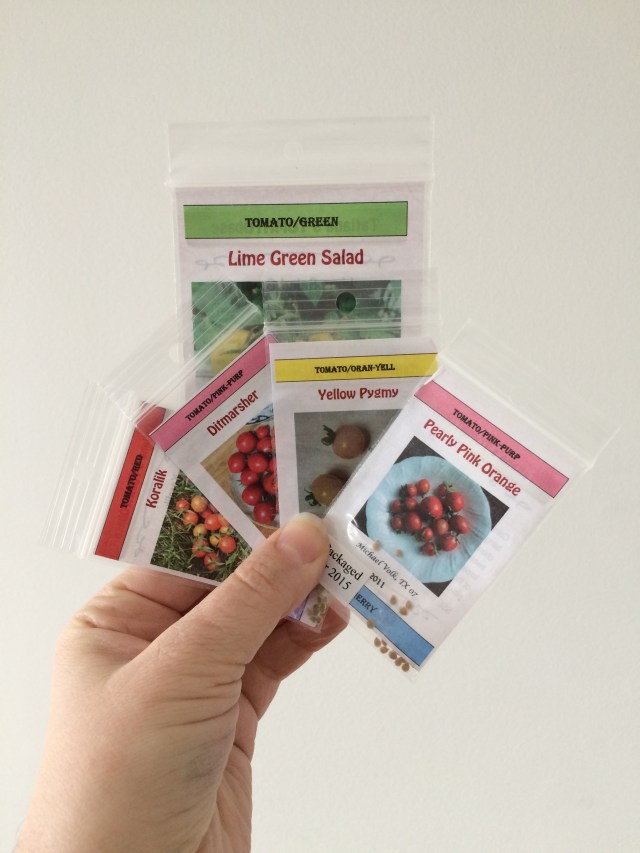
Koralik – I have not grown this variety but it was recommended somewhere (I can’t remember where).
Golden Bison – I think this one was also recommended to me – I’ve been on the hunt for a determinate yellow that I will really enjoy so the pressure is really on for this one to perform well.

I have started growing a number of tumbling and dwarf varieties the last couple of years – these are both a type of determinate tomatoes but I figured I would separate them as I like to consider them under their own categories. These tomatoes are pretty much ideal for me because I can put them almost anywhere and they will perform well. A few years ago I was watching the best cooking show ever (Jamie At Home) and he was talking about growing these cherry tomatoes in old spaghetti sauce cans. At the time I thought it was BS because the cans were fairly small and there was no way I thought a tomato plant would thrive in those conditions. But what I didn’t realize at the time is that he was actually growing dwarf varieties. Silly me. Last year was my first year growing a dwarf variety (Red Robin) and I actually ended up putting multiple plants in to a 12″ terra cotta pot (of course with basil seeds sprinkled in the bottom of the pot) and the plants thrived. I’m going to experiment with some smaller pots this year – I’ll just need to be diligent about watering them really well daily. With tumbling varieties I kind of do the same thing except I stick them in with other determinates (I’ve been known to grow up to 3 tumbling tomatoes in a large planter with another determinate and basil – crazy, I know!). Tumbling varieties are ideal for hanging baskets or trailing over the edge of a pot. If you are going to stick them in a pot with other tomatoes, just ensure that the pot is heavy and sturdy enough to hold the weight – I learned the hard way last year when we had a heavy windstorm that blew some pots that may have been a bit top heavy right off the deck.

Tumbling varieties I will be growing this year:
Tumbler – I’ve grown this one for about 4 years. It is the earliest tomato to produce fruit in my garden.
Ditmarsher – This one is new-to-me this year and I first read about it on You Grow Girl.
Pearly Pink Orange – I’ve also never grown this but found it on my search for tumbling varieties. It is actually supposed to be just pink, so who knows where the orange came from, but I guess I will find out for myself.

Dwarf varieties I will be growing this year:
Red Robin – This plant produced so many fruit last year for such a little plant.
Adrina – I found this one when searching for dwarf tomatoes so growing it will be a total experiment.
Hahm Gelbe – Another one I read about on You Grow Girl as well as heard about on her podcast. I’ve been on the search for seeds for a couple of years and was very excited to finally get a hold of some. – Lime Green Salad – Again, one I first read about on You Grow Girl and I’m most excited for the crinkled leaves.
Yellow Pygmy – I will admit that I chose this one based on the name and if it turns out to be a good tomato it will be a total plus.

So that’s the tomato list for this year. I’m unbelievably excited for the growing season this year and hopefully I’ll have lots of good things to report back on these tomatoes. And I’m also curious to see how I can tetris all of these plants in to my small garden! Are you trying any new varieties this year? I’d love to hear about them!

Tomato seed sources (I am not associated with or compensated by these companies, I just love and support the work that they do in preserving rare and heirloom seeds): Baker Creek Heirloom Seeds, Tatiana’s Tomatobase, Heritage Harvest Seed, Seed Savers Exchange, West Coast Seeds, Urban Harvest

The Garden January 2015

As you can see there is not too much going on in the garden. Everything is covered in a thick blanket of snow and ice. It’s pretty difficult right now to picture a lush, thriving garden, but I’ve been trying not to dwell on it too much – it can be pretty easy to get depressed this time of year. I’ve been keeping myself busy with ordering new seeds (the first of the new seeds arrived in the mail this week!), taking inventory of my seed collection, and making list and schedules of things I want to grow this year. I think we’re at 24 tomato varieties and 23 pepper varieties (!!!). And even though my garden is still a few months away from thaw, the weather has been unseasonably warm this week so I’m feeling somewhat optimistic!

2015/01/img_0282.jpg

Have you been doing any garden planning yet?

Pickled Crack Vegetables

A couple of years ago, I was at my local farmer’s market and found myself standing in front of a large display of pickled things – there were cucumber pickles, pickled asparagus, canned fruit, jams, and many other things, including a tasty looking jar of pickled mixed vegetables. Not looking at the price, I grabbed the jar of pickled vegetables, along with a few other fresh things, paid, and took everything home. As I normally do on weekends, I made myself a sandwich for lunch and then I cracked opened the jar of pickles and put a few on the side of my plate. As soon as I started in on the pickles I exclaimed “Holy crap, these are really good!” and then promptly ate the rest of the jar of pickles. The next weekend, I went back and bought another jar. But this time was a bit different – I didn’t pick up anything else. I brought the jar to the register and the clerk told me it would be $6! SIX DOLLARS. FOR ONE PINT SIZED JAR OF PICKLED VEGETABLES. But they were so good. And I had too much pride to put the jar back at that point, so I paid and took the pickles home. And ate the whole jar in one sitting. This continued on for a few more weeks until one Saturday I sent my husband out by himself to the market with a list. Of course the list included a jar of pickles. So about an hour later he comes home with the jar of pickles in his hand, looks at me and says “You know these are $6 a jar, right? SIX DOLLARS A JAR?!! That’s like a third of our grocery budget going towards your expensive pickle habit!”. Maybe those weren’t the exact words, but I do remember the shame I felt. It was time for a change but I couldn’t give up the pickles, I was addicted! And that is how they became known around our house as pickled crack vegetables.

So once my shameful secret was out, I needed to find some way of satisfying my addiction, but also not spending a third of our grocery budget on pickles. Now I’m definitely someone who wants to support our local farmers, but six dollars for a jar of pickles is a bit ridiculous. And honestly, isn’t saving money the point of preserving your own food? Also, I can somewhat justify replicating the recipe because I still buy a lot of produce from them throughout the year. My apologies if I have offended anyone – I had to do what I had to do.

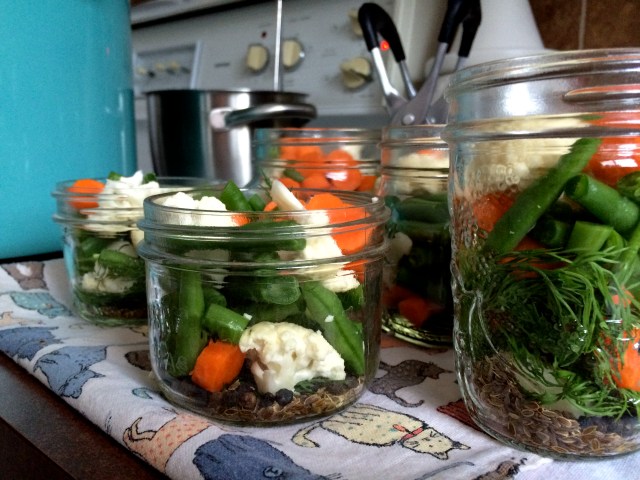
Now let’s talk about the crack pickles themselves. It’s a really classic basic recipe that you can simply customize to fit your own tastes. You should have a basic knowledge of canning before you begin, but a beginner could easily make this recipe as well. I always use the same vegetables (carrots, beans & cauliflower) but you could mix it up if you want (onions, peppers, peas, beets, etc). What really makes the recipe is the seasoning – I like to keep it really simple so I use fresh garlic, fresh dill, black peppercorns and dry dill seed. The only other ingredients you’ll need besides this and the vegetables are pickling vinegar and pickling salt.

IMG_2972

Pickled Crack Vegetables Recipe

Ingredients
– Approximately 2 cups of each fresh vegetable – I use cauliflower, green beans, and carrots, just make sure they are the freshest vegetables you can find (I’ve used grocery store vegetables before, no big deal!)
– Fresh garlic cloves, skins removed (amount will depend on how much you like garlic – I usually put in 2-3 cloves per jar)
– Fresh dill – approximately one sprig per jar
– Black peppercorns and dill seed (approximately 1/2 teaspoon each per jar)
– 2 1/2 cups of pickling vinegar
– 2 1/2 cups of tap water
– 1/4 cup pickling salt (I use kosher)

Instructions
1. Sterilize all your jars, lids and utensils (I do this in the dishwasher or you can do it in a pot of boiling water).
2. Prepare your boiling water bath.
3. Prepare your vegetables by washing them, removing the ends and any bruises or deformities, and cutting them into manageable pieces.
4. Bring your vinegar, water and salt to a boil in a non-reactive pot and simmer while you prepare the jars.
5. Put your herbs and spices in to the sterilized jars and then add your vegetables.
6. Ladle the hot liquid in to the jars leaving approximately 1/2 inch of head space.
7. Wipe the jar rims with a wet paper towel and add lids (do not over-tighten)
8. Carefully lower the jars in to the boiling water bath and process for 10-15 minutes depending on the size of your jars.
9. Carefully remove the jars, being careful not to tip them, and place on a dish towel on a flat surface. After a couple of hours, check to make sure all of your jars have sealed (I love waiting to hear that popping sound!). Do not disturb the sealed jars for 24 hours. If any jars did not seal, put them in the fridge and eat within a couple of weeks.
10. Enjoy your crack pickles! You should eat them within a year but they probably won’t last that long since they are so good!

IMG_2984

My favorite thing about this recipe is that it is so classic and easy. As much as I love experimenting with different hot peppers and spices in my canning, I really love that classic pickled taste.

Casual Fridays Part 4

I don’t know about you, but this has been a long week and I think it is safe to say that I miss the days of sleeping in and not having to leave my house. But I am excited to work on a few projects this weekend and I have picked up a bit of inspiration online here and there throughout the week:

1(27)

1. I love this woven circle mat tutorial via A Beautiful Mess and I have added it on to my projects list. And is something I would actually make! I can just imagine the possibilities with this.

2. Planning on paper via Uppercase. I don’t know about you, but I’ve been feeling somewhat uninspired and unmotivated this week – I think it has to do with coming out of vacation mode, as well as the terrible weather we’ve been experiencing the last couple of weeks. I really want to sit down and make a planned out schedule of my personal monthly goals, as well as for my upcoming gardening season (seed starting dates, transplant dates, etc), so I’m going to put all of my pretty stationary to use and actually accomplish a plan for my future accomplishments (if that makes sense). There is just something about putting it down on paper that makes the process so much more inspiring for me.

3. Seamwork Magazine Issue 2 has come out this week! The best part is that I finally broke down and bought myself an iPad (RIP to my poor 6 year old Macbook), so I’m totally in to reading magazines online and watching knitting tutorial videos on my lap while I have a set of needles in my hands. Anyway, this magazine is a wonderful read for the sewer as it teaches lots of various techniques I would not have even considered before – plus the photography is beautiful.

4. Jerrica Dishcloth via Knit Picks for the 52 weeks of free dishcloth patterns. This looks like a totally quick and easy knit, plus I need new dishcloths so why not make some. I’m going to keep my eye out for some inexpensive cotton yarn.

5. Caramelized onion & goat cheese tart via Go Make Me looks really good! And simple. I think I need something delicious, new, and simple to make this weekend!

I’ve got a few really good posts planned for next week so be sure to come back and check them out. In the meantime, I hope everyone has a wonderful and restful weekend – stay warm!